An enduring beacon of the Indian Ocean, illuminating the maritime heritage, craftsmanship, and timeless identity of Maliku.
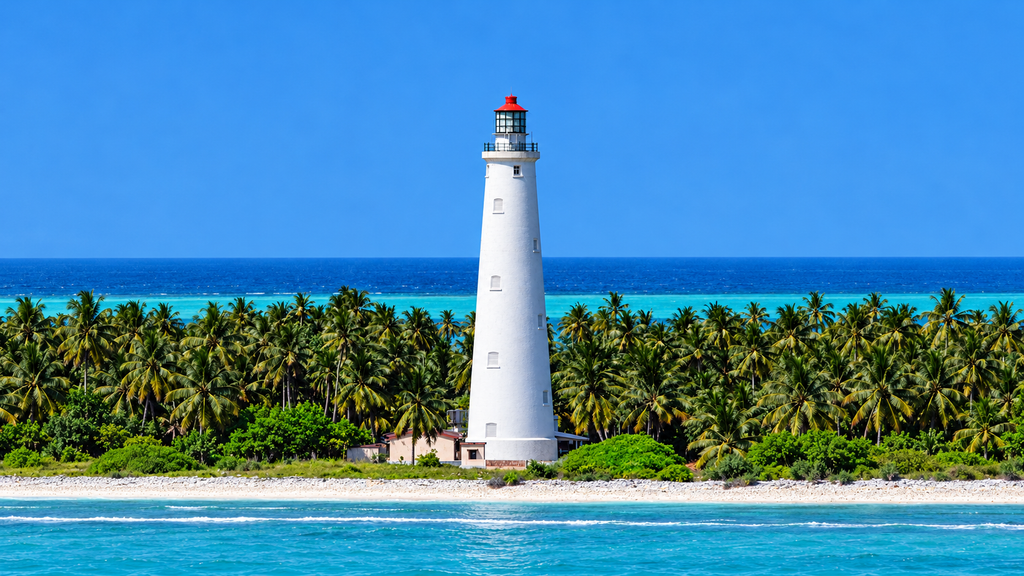
The historic Lighthouse of Maliku, commissioned on 2 February 1885, viewed from its eastern side against the Arabian Sea.
Some legends are remembered through the extraordinary lives of individuals, while others stand silently across generations, bearing witness to the passage of time. At the southern end of Maliku (Minicoy), rising majestically above the coconut palms and facing the vast Indian Ocean, stands one such legend — the historic Lighthouse of Maliku.
Far more than a towering structure of bricks and mortar, it is a monument of maritime history, a symbol of the island's strategic importance, a tribute to the craftsmanship of its people, and an enduring guardian of seafarers navigating the surrounding waters. Since its commissioning on 2 February 1885, the lighthouse has become inseparable from the identity and heritage of Maliku.
Long before its construction, Maliku was already a land of accomplished navigators, fishermen, sailors, and boat builders. Its people possessed an intimate knowledge of the sea, reading the winds, currents, reefs, and stars with remarkable skill. Traditional vessels maintained commercial and cultural connections with the Indian mainland, Ceylon, the Maldives, and other distant maritime destinations. The island's relationship with the ocean was deeply established long before modern navigational technology reached its shores.
The opening of the Suez Canal in 1869 transformed international maritime transportation, shortening the sea route between Europe and Asia and increasing the importance of shipping lanes across the Indian Ocean. Situated near these important passages, Maliku attracted the attention of British maritime authorities, who recognised the need for a permanent navigational light to assist passing vessels.
In 1882, during the administration of Lord Ripon, the British Government decided to construct a lighthouse on Minicoy Island. The proposal was discussed in the British House of Commons on 14 November 1882, with arrangements being made for the construction of a lighthouse that would improve navigation along this strategically important route.
The lighthouse's history contains an especially meaningful chapter belonging to the people of Maliku themselves. In May 1883, the foundation stone was ceremonially laid by Howah Manika Bephanu, the youngest daughter of M. Bephanu, the then Amin of Minicoy. Her participation is preserved in the historical accounts of the Directorate General of Lighthouses and Lightships and the District Census Handbook, Lakshadweep.
This remarkable event deserves an honoured place in the historical memory of Maliku. The foundation of one of the island's most celebrated landmarks was laid by a daughter of the island. Her name remains associated with a monument that would subsequently serve generations of mariners from across the world. Although further details of her personal life remain to be established, her documented participation gives the lighthouse a distinctly local historical identity.
Her father, M. Bephanu, held the position of Amin during this important period. While historical accounts identify his name and office, further research is required to establish his family background, village affiliation, and other personal details.
The construction represented an exceptional engineering undertaking for a remote coral island in the nineteenth century. Specially manufactured black bricks were brought from Birmingham in England, while special cement was imported from Holland. Structural steel, hardware, timber, and components of the lighting apparatus were transported by ship. The Directorate General of Lighthouses and Lightships records that a specially assigned vessel remained anchored at Minicoy during the construction project.
Skilled masons and labourers were brought from Galle in Ceylon, now Sri Lanka, some having previously worked on the Basses lighthouses. An additional historical account, Light on the Forelands by Ken and Clifford Trethewey (2022), specifically states that Tamil builders completed the tower in March 1884. This published reference adds an important dimension to the history of the lighthouse by identifying the contribution of Tamil craftsmen.
The same book identifies a diary written by William Griffiths, a mason who travelled to Minicoy during the construction period. Dating from 1882 to 1884, the diary is reported to be preserved at the Pembrokeshire Archives in Wales, under reference HDX/5. Its original contents remain an important subject for further historical investigation.
The official Census account also preserves a particularly important acknowledgment of the island's own craftsmen. The people of Maliku quickly demonstrated construction skills comparable to those of the experienced masons brought from overseas.
This achievement reflects the practical knowledge, adaptability, and craftsmanship that had long characterised the island's boat builders and working communities. The lighthouse was therefore not simply an engineering project undertaken by foreign authorities. Its construction brought together Tamil builders, craftsmen from Ceylon, and the skilled people of Maliku, creating a monument shaped by contributions from different communities.
The tower was structurally completed in March 1884, and its original optical equipment, supplied by Chance Brothers of Birmingham, was installed in December of that year. The lighthouse was built as a substantial cylindrical masonry tower, carefully designed to withstand the demanding conditions of a tropical marine environment.
The Lighthouse of Maliku is commonly described as standing 49.5 metres (approximately 162 feet) high, with the light positioned at a focal height of approximately 47 metres (154 feet) above sea level. A more recent heritage description submitted by the Directorate General of Lighthouses and Lightships to IALA also identifies a structural tower measurement of 41.7 metres. These measurements refer to different descriptions of the lighthouse structure and should not be treated as interchangeable.
Its engineering features are equally remarkable. The cylindrical tower has substantial masonry walls, approximately two metres thick at the base and narrowing towards the upper levels. Its internal arrangement includes six floors, historically associated with the accommodation of lighthouse personnel and the storage of kerosene required for operating the light.
A steel spiral staircase rises through the interior, allowing access to the upper floors and lantern. The IALA heritage account describes an internal staircase one metre wide, comprising 174 steps around a central steel tube, while its visitor information identifies 216 steps for the climb to the top. Both figures appear in the published heritage description.
The summit provides an impressive panoramic view of the island, its coconut groves, surrounding reefs, lagoon, and the vast expanse of the Indian Ocean. From this height, visitors can appreciate the distinctive geographical setting that made Maliku such an important navigational landmark.
The lighthouse's powerful light has a published range of 40 nautical miles, equivalent to approximately 74 kilometres, under the relevant visibility conditions. Its characteristic white flash occurs every 15 seconds, allowing mariners to recognise the light and distinguish it from other navigational signals.
The range of a lighthouse is influenced by atmospheric visibility, the height of the observer1navigational characteristic rather than a guarantee that the beam can always be seen from that distance.
On 2 February 1885, the Lighthouse of Maliku was formally commissioned in the presence of the Amin of Minicoy and Sir James Douglass, who had travelled from England. From that day, its light became an important navigational reference for vessels crossing the surrounding waters.
The construction of the lighthouse also represented a substantial financial undertaking. An important reference appears in the British House of Commons proceedings of 10 August 1885, which recorded that nearly £14,000 sterling from surplus lighthouse dues had been applied towards the cost of constructing the Minicoy Lighthouse during 1883–84.
This figure is valuable historical evidence of the financial resources committed to the project, although it should not be treated as the confirmed total construction cost. The complete original expenditure has not yet been established from the records examined.
A later parliamentary debate, held on 17 May 1960, provides further information about the original financing. During the Second Reading of the Merchant Shipping (Minicoy Lighthouse) Bill, the Minister of State for Commonwealth Relations, Mr. C. J. M. Alport, explained that the lighthouse had been constructed by the British Board of Trade with funds provided by the Public Works Loan Commissioners. The statement adds an important detail to the financial history of the project, demonstrating the involvement of British public financing arrangements alongside lighthouse revenue.
The early decades of the lighthouse were closely associated with the challenges of operating a maritime installation on a remote island. A valuable glimpse of those years survives in the General Report on the Operations of the Survey of India Department during 1889–90, published in Calcutta in 1891.
Surveyor G. Belcham, who arrived at Minicoy on 15 February 1890, visited the lighthouse establishment and recorded details of its personnel. According to his account, the lighthouse staff consisted of one European officer in charge, one Portuguese assistant light keeper, and four supporting workers drawn from Ceylon and Minicoy.
Belcham also recorded the monthly salaries paid to members of the establishment. The four supporting workers received Rs. 20 per month each, while the Portuguese assistant light keeper received Rs. 60 per month, together with an additional allowance for rice.
These figures offer a rare glimpse into the economic conditions of lighthouse employment during the late nineteenth century. Behind the powerful beam stood ordinary workers whose duties involved maintaining equipment, attending to the light, and ensuring the continued operation of a vital maritime service.
The report also reveals that service at the lighthouse was not without hardship. Belcham recorded concerns about illness at the station and the difficulties associated with serving in such a remote location. He noted that three members of the lighthouse establishment had died on the island during the preceding years. The light keeper and assistant were generally relieved every three or four months, reflecting the arrangements made for staffing isolated maritime stations.
These observations are particularly valuable because they preserve the human side of the lighthouse's history. While the tower's construction and inauguration are well documented, the experiences of the men who maintained its light are much less frequently remembered.
Another personal dimension emerges from Light on the Forelands, which describes the career of Henry Thomas Knott, an experienced British lighthouse keeper whom the authors believe was appointed Principal Keeper at Minicoy around 1888. His posting illustrates the international network of lighthouse personnel employed at distant maritime stations. The book recounts hardships associated with his service, although parts of his story are reconstructed from family recollections rather than complete official records.
The lives of these workers deserve recognition alongside the achievements of the engineers and administrators. Whether they came from Maliku, Ceylon, or elsewhere, their labour helped sustain a vital maritime service under challenging conditions.
Belcham's report also described an active maritime community whose traditional dhonis traded with Calicut, Colombo, and even Calcutta. Local carpenters and boat builders possessed practical maritime skills, while fishing and coconut cultivation remained important occupations. These observations reveal that Maliku was not merely a remote location for an international lighthouse. It was already a community of experienced seafarers, with its own commercial connections and navigational traditions.
During the same visit, Belcham investigated the proposed establishment of a tidal observatory at Minicoy. This scientific project was distinct from the lighthouse, but it further demonstrated the island's growing importance as a location for maritime and oceanographic observation.
The lighthouse continued to evolve with advances in technology. In 1928, the original wick-lamp arrangement was replaced by a petroleum vapour burner, considerably improving the intensity of its light.
Its administrative journey was equally distinctive. The lighthouse remained under the direct control of the British Board of Trade until 1934, after which it was placed under the charge of the Superintendent of the Imperial Lighthouse Service at Colombo. This arrangement continued even after India achieved independence in 1947.
The subsequent transfer of the lighthouse to India became the subject of a significant parliamentary discussion in the United Kingdom.
On 17 May 1960, the British House of Commons debated the Merchant Shipping (Minicoy Lighthouse) Bill, recorded in Hansard, Volume 623, columns 1137–1141. The proceedings provide valuable documentary evidence of the lighthouse's unusual administrative and financial position after Indian independence.
During the debate, Mr. C. J. M. Alport explained that although Minicoy Island had become part of independent India, the lighthouse itself remained legally the property of the United Kingdom Government. The Government of India had requested in 1950 that the lighthouse, situated on Indian territory, should be transferred to Indian administration without charge and together with its assets.
The British Government accepted the principle of the request. Consequently, the Government of India assumed management of the lighthouse on 2 April 1956, while the legal transfer of ownership and settlement of financial matters were left for subsequent legislation.
The parliamentary debate also provides an unusually detailed explanation of the lighthouse's financial arrangements. For many years, the Minicoy Lighthouse had been administered jointly with the Great and Little Basses Lighthouses off Ceylon, and their revenue and expenditure had been accounted for together in the General Lighthouse Fund.
Because the accounts had not separately distinguished the financial position of Minicoy, the British authorities undertook an assessment of the assets attributable to the lighthouse as at 2 April 1956.
The parliamentary statement recorded an estimated net excess of income over expenditure of £116,000 for the jointly administered lighthouse establishments. From this, £62,000 was deducted in respect of pension liabilities, leaving £54,000 for allocation.
Based on the relative costs of operating and maintaining the establishments over a seven-year period, Minicoy's share was assessed at 28%, amounting to approximately £15,000. With the conversion rate against the Indian Rupee (INR) during 1882–1885 ranging between INR 16 and 18 per pound sterling, the approximate total volume comes to ₹2.4–2.7 lakhs.
The Minister further explained that this sum, together with lighthouse dues collected since April 1956 estimated at approximately £10,000, and interest at four per cent per annum, would be payable to the Government of India from the General Lighthouse Fund under the proposed legislation.
These amounts concerned the settlement of accumulated funds and financial obligations associated with the transfer. They were not the original construction cost of the lighthouse.
The parliamentary discussion is important because it demonstrates that the transfer of the Lighthouse of Maliku was not merely a ceremonial change of flag. It involved questions of sovereignty, legal ownership, maritime administration, public finance, and international cooperation.
The Bill received support in the House of Commons, and the resulting Merchant Shipping (Minicoy Lighthouse) Act, 1960, received Royal Assent on 2 June 1960. The Directorate General of Lighthouses and Lightships records 19 September 1963 as the date of the eventual de jure transfer. Thus, the administrative handover in 1956, the British legislation in 1960, and the formal legal transfer recorded in 1963 represent distinct stages in the lighthouse's transition to Indian authority.
A major technological transformation followed in 1968, when the earlier optical equipment was replaced with an improved first-order optical assembly and a more powerful petroleum vapour burner supplied by BBT of Paris.
Another important milestone occurred on 31 January 1982, when a Canadian-manufactured Nautel Radio Beacon was brought into operation at Minicoy Lighthouse. Unlike the traditional beam of light, which helped mariners visually identify their position, the Radio Beacon transmitted navigational radio signals that could be received by appropriately equipped vessels even when the lighthouse itself was not visible.
On 21 March 1985, a RACON, or radar beacon, was added. This equipment responded to signals from ships' radar systems, enabling navigators to identify the lighthouse's position on their radar displays.
The year 1985 also marked the centenary of the Lighthouse of Maliku. On 2 February 1985, the Government of India issued a commemorative postage stamp of Re. 1 denomination, recognising the historical and maritime significance of the lighthouse.
The lighting system underwent further modernisation on 9 May 1995, when a 400-watt metal halide lamp replaced the earlier petroleum vapour light source.
A particularly significant technological development followed on 15 August 1998, when Differential Global Positioning System (DGPS) equipment was integrated into the Minicoy Lighthouse Station. The DGPS system was designed to improve the positional accuracy available to maritime users by transmitting correction information to suitably equipped receivers. With this advancement, the earlier standalone Radio Beacon service was discontinued, and Minicoy became a DGPS reference station.
The station continued to develop in the twenty-first century. In 2014, a shore station associated with the National Automatic Identification System was introduced, supporting the exchange of vessel-identification and movement information. In 2018, the DGPS infrastructure was modernised to DGNSS, extending the station's role in satellite-based maritime navigation.
These developments represent an extraordinary transformation in the history of the Lighthouse of Maliku. What began in 1885 as a powerful light guiding mariners across the Indian Ocean evolved into a maritime facility associated with radio navigation, radar identification, satellite-positioning corrections, and vessel-information systems.
The original lighthouse tower remains the historic heart of this continuing development. Its technologies have changed, but its fundamental purpose — assisting safe navigation — has endured.
The lighthouse has also gained increasing recognition as a heritage landmark. In its nomination for IALA Heritage Lighthouse of the Year 2025, submitted by the Directorate General of Lighthouses and Lightships, its architectural value, historic maritime role, and continued technological relevance were highlighted.
The heritage description records the preservation and display of historic lighting equipment, kerosene storage arrangements, and other objects associated with the lighthouse's early operation. These surviving elements help visitors understand the practical challenges of maintaining a navigational light before the development of modern automated systems.
The lighthouse's remarkable architectural survival, combined with its continuing maritime function, makes it an exceptional link between nineteenth-century engineering and modern navigational science.
Then and Now — The Lighthouse Across Generations
Then, in the nineteenth century, the Lighthouse of Maliku represented a remarkable advancement in maritime navigation. Its construction required the transportation of specialised materials, the cooperation of workers from different regions, and the participation of skilled local islanders. Its light was maintained through equipment and practices that demanded constant human attention.
For the traditional seafarers of Maliku, whose knowledge of navigation had been inherited through generations, the lighthouse introduced a new and powerful landmark into their familiar maritime environment. It stood alongside the island's established traditions of observing the stars, understanding the sea, and navigating by experience.
Now, in the twenty-first century, the lighthouse continues to stand as a recognisable symbol of Maliku's maritime identity. The world of navigation has changed dramatically. Modern vessels depend on satellite positioning, electronic charts, advanced communication systems, and sophisticated navigational equipment. Nevertheless, the lighthouse remains an important physical landmark and a reminder of the enduring value of navigational safety.
The landscape around it has also changed. Generations have passed, administrative systems have evolved, and the lives of the islanders have been transformed by education, transportation, communication, and modern development. Yet the lighthouse still rises above the coconut palms, connecting the present generation with the world of their ancestors.
To earlier generations, it was a newly constructed beacon representing a changing age of maritime navigation. To the present generation, it is a treasured historical monument, an enduring feature of the island's landscape, and a source of collective pride.
Then, its construction brought together British maritime authorities, Tamil builders, craftsmen from Ceylon, and the skilled people of Maliku. Now, its history offers an opportunity to recognise every contribution, particularly those of local islanders and ordinary workers whose efforts may otherwise be overshadowed by the names of officials and engineers.
Then, Howah Manika stood at the beginning of its story, laying its foundation stone in 1883. Now, more than a century later, her name deserves renewed recognition among the people whose history the lighthouse represents.
Then, the lighthouse was operated through labour-intensive lighting technology, maintained by keepers and supporting staff who served in difficult conditions. Now, technological progress has transformed maritime navigation, but the human dedication that sustained the lighthouse in its early years remains an important part of its heritage.
Then, the lighthouse was administered from distant colonial offices. Now, it stands under Indian administration, its transfer documented through parliamentary debates, legislation, and the formal assumption of responsibility by the Government of India.
Then, its lamp illuminated the sea for vessels navigating without the benefits of modern satellite technology. Now, its maritime legacy extends beyond visible light into the world of radio signals, radar, and satellite navigation. The technology has evolved, but the mission remains the same: to guide and safeguard those who travel across the sea.
The Lighthouse of Maliku has witnessed the transformation from traditional sailing vessels to modern ocean-going ships, from colonial maritime administration to independent India, and from the age of oil lamps to contemporary navigational technology.
Yet its greatest significance lies beyond engineering and administration. It is part of the living memory of Maliku — a landmark known to generations of islanders, a reminder of their maritime heritage, and a monument that connects the island's past with its present.
The story of the lighthouse is therefore not simply the story of a British construction project. It is also the story of Howah Manika, Amin Bephanu, the Tamil builders, the local craftsmen, the workers from Ceylon, the lighthouse keepers, the navigators, and the wider seafaring community of Maliku.
As the years continue to pass, the lighthouse remains a silent witness to the island's changing history. Its foundations preserve the memory of the nineteenth century, its walls reflect the craftsmanship of earlier generations, and its continuing presence offers inspiration to those who will inherit the island's heritage.
The Lighthouse of Maliku is not merely a monument that has survived history. It is a legend that has lived through history — then, now, and for generations yet to come.
Historical Sources and References
- Census of India 2011, District Census Handbook, Lakshadweep, Series 32, Part XII-B, Directorate of Census Operations, Lakshadweep. “Minicoy Light House,” Motif section.
- Survey of India Department, General Report on the Operations of the Survey of India Department during 1889–90, Calcutta, 1891. “Extracts from a Report on the Island of Minicoy,” by G. Belcham, Surveyor, Second Grade.
- Ken and Clifford Trethewey, Light on the Forelands, Jazz-Fusion Books, 2022, pages 266–268. Historical account of Henry Thomas Knott, the Tamil builders, and the diary of William Griffiths, Pembrokeshire Archives, reference HDX/5.
- British Parliamentary Debates, House of Commons, 14 November 1882, “India—Lighthouse on Minikoi.”
https://api.parliament.uk/historic-hansard/commons/1882/nov/14/india-lighthouse-on-minikoi - British Parliamentary Debates, House of Commons, 10 August 1885, “Ceylon—Lighthouses—The Basses Lights.”
https://api.parliament.uk/historic-hansard/commons/1885/aug/10/ceylon-lighthouses-the-basses-lights - Hansard, House of Commons, 17 May 1960, Volume 623, columns 1137–1141, “Merchant Shipping (Mimcoy Lighthouse) Bell” (as transcribed in the online Hansard archive). Parliamentary debate on the transfer of the Minicoy Lighthouse and associated financial settlement.
https://hansard.parliament.uk/commons/1960-05-17/debates/9526fe23-a8be-4cd0-b741-73ad24ac2c42/CommonsChamber - Merchant Shipping (Minicoy Lighthouse) Act, 1960, Royal Assent recorded in the British House of Commons on 2 June 1960.
https://api.parliament.uk/historic-hansard/commons/1960/jun/02/royal-assent - Directorate General of Lighthouses and Lightships, Government of India, Minicoy South Lighthouse and DGPS Station.
https://www.dgll.nic.in/DGLL-light-house-location/about-kochi/minicoy-south-lighthouse-dgps-station - IALA Heritage, Minicoy Lighthouse (South), heritage nomination information submitted by the Directorate General of Lighthouses and Lightships, 2025.
https://heritage.iala.int/lighthouses/minicoy-lighthouse-south/ - Maliku Museum Collection, historical description of the Minicoy Lighthouse and its maritime heritage.
https://www.seacology.org/wp-content/uploads/2020/05/Maliku-Museum-collection-for-seacology.pdf - PAHAR Digital Archive, General Reports on Operations of the Survey of India.
https://pahar.in/general-reports-on-operations-of-the-survey-of-india/